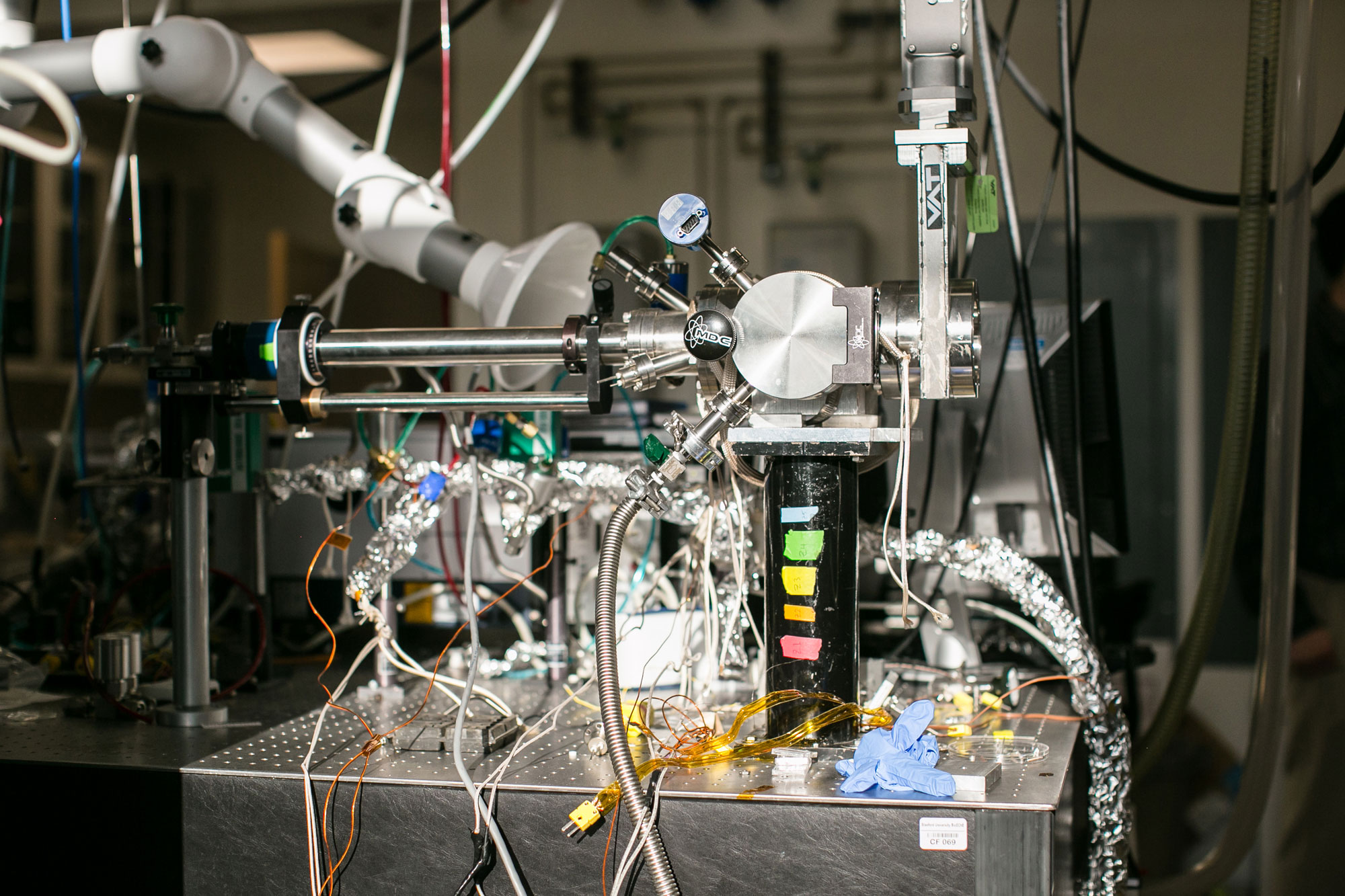
Research Area: Organic-based Nanoscale Thin Films (MLD)
The ability to deposit nanoscale organic-based films with molecular-level control is of importance for a range of applications for which precision in composition and architecture is crucial, such as nanoelectronics and catalysis. We are exploring the technique of molecular layer deposition (MLD) to deposit ultra-thin organic and hybrid metal-organic thin films. MLD is performed by introducing organic reactants that undergo self-saturating surface reactions in a sequential scheme to grow films in a layer-by-layer manner, analogous to ALD. For hybrid films, the organic reactants are alternated with metal-organic precursors from ALD to form coordination polymers. MLD organic and metal-organic films have many advantages over traditional chemical vapor deposition methods: precise control over film thickness, conformal coating of surfaces, and unprecedented control over the film composition.
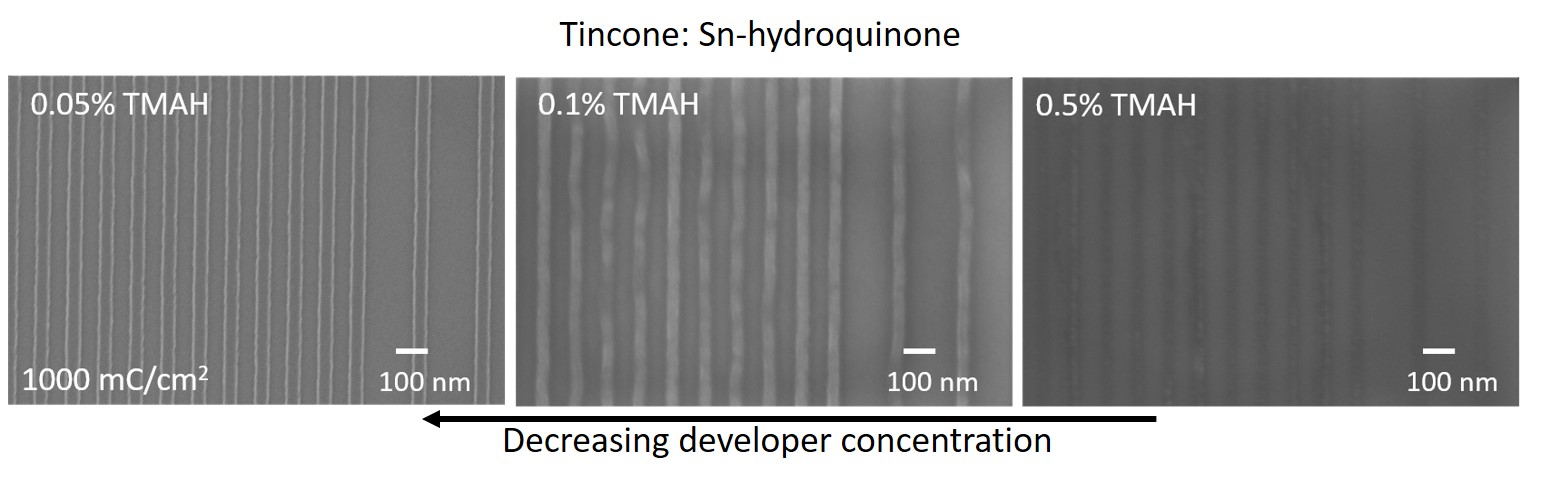
Above: SEM images of tincone films after e-beam exposure and development in tetramethylammonium hydroxide (TMAH) at varying concentrations. The tincone organic linker is hydroquinone. The figure shows that decreasing the developer concentration gives a better resist resolution.
Our group is currently focused on metal-organic MLD films as photoresists for EUV lithography. We leverage the tunability of MLD reactants to control the photoresist composition, thereby studying the effect of different chemical and structural motifs on lithographic performance. In these studies, we also examine the effects of the developer and deposition conditions on the resist properties. In addition to our work with lithography, we are studying hybrid MLD-derived thin films as electrocatalysts for the hydrogen evolution reaction.
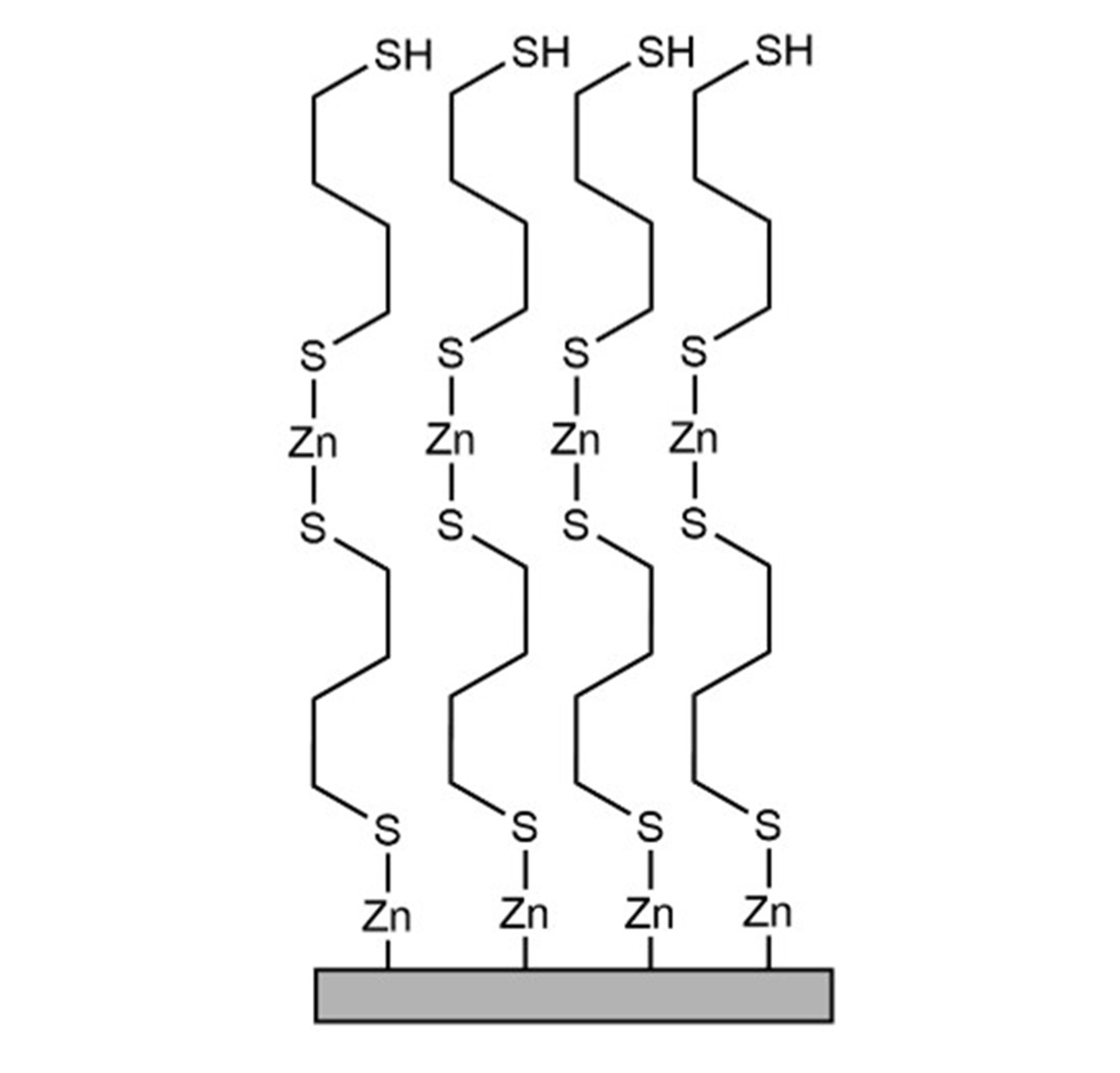
Above: Ideal schematic of zinc thiolate film deposited via ALD/MLD.